“My faith defines how I see the world; I see Christ in everything. I believe in God the Father, Son, and Holy Spirit—an all-powerful Creator who chose to meet us on our level. By sending His Son to be one of us, even for a short time. God spoke our language, replacing fear with understanding and showing us the way to salvation.
But believing doesn’t mean I have all the answers. I am a seeker on a spiritual journey, viewing my faith as an active pilgrimage rather than a static fortress. Living out this faith is a daily struggle, but my dedication is absolute. I hold tightly to the grace of a God who welcomes my questions, confident that He will never punish me for trying to understand Him better.”
The Human Fingerprints on a Divine Story
Part of being a seeker means looking at our sacred texts with fresh eyes, rather than letting familiar passages become stale or overlooked. It involves actively seeking new perspectives and challenging preconceived notions.
The Bible didn’t fall out of heaven all at once. Instead, it is the product of thousands of years of oral traditions, unknown numbers of writers, documents, editors, and biblical redactors. This meticulous curation, arranging, and editing is spread out over a span of multiple centuries—millennia, even. The authors came from vastly different cultural contexts and rarely shared the same theology.
Written between 2,000 and 3,000 years ago, the Bible is naturally filled with the localized knowledge and cultural norms of that period—some of which you and I rejected long ago. The text contains passages asserting that women are property, that homosexuals ought to be put to death, or that a child who talks back to his parents should be stoned at the gates of the city. To our modern moral compass, those ideas are absurd.
As the late Bishop John Shelby Spong famously noted:
“God is not a Christian, God is not a Jew, or a Muslim, or a Hindu, or a Buddhist. All of those are human systems that human beings have created to try to help us walk into the mystery of God. I honor my tradition; I walk through my tradition, but I don’t think my tradition defines God; I think it only points me to God.”
Theology is often a misnomer because it isn’t strictly the study of God; it’s the study of observations we have made about the world that have led us to ideas about God.
Expanding the Borders of the Kingdom
When we insist on rigid, exclusive doctrinal viewpoints, we end up distorting the very heart of the Gospel. Author Brian McLaren has lamented how conventional interpretations of verses like John 14:6 (”I am the way, the truth, and the life...”) force us to forget the actual way Jesus lived:
“Forget everything you’ve seen in me, the way I’ve lived and treated people, the way that I have accepted prostitutes and tax collectors, the way I have welcomed outsiders... Believe instead that God will reject everyone except people who share doctrinal viewpoints with me, because I won’t let anyone get to the Father unless they get by me first by joining my new religion.”
When the institutional church reduces a love story to an exclusive club manual, it makes you want to cry, groan, or scream. You know what’s wrong with conventional Christianity? Carl McColman captured it perfectly: It’s like learning that someone truly beautiful and wonderful has fallen in love with you—but all your mutual friends keep telling you how you must act or behave to be “worthy” of that love. All their advice, instructions, and demands create such a din that it’s easy to forget this was all about love to begin with.
I have reached a point where I stopped needing other religions to be wrong for mine to be right. If the gospel isn’t good news for everybody, then as Rob Bell famously argued in Love Wins, it isn’t good news for anybody. We need to be far more curious in our faith and less fearful.
Who said God is limited to Christians? That would be a puny God—a God I don’t believe in. Mine can create universes by simply declaring, “Let there be light.”
Radical Love and Radical Truth
Even from outside the faith, observers can see the staggering weight of what cosmic stakes actually mean. The illusion of safety shouldn’t make us casual. Consider what the illusionist and outspoken atheist Penn Jillette remarked about the urgency of true belief:
“I’ve always said that I don’t respect people who don’t proselytize. I don’t respect that at all. If you believe that there’s a heaven and a hell, and people could be going to hell or not getting eternal life, and you think that it’s not really worth telling them this because it would make it socially awkward... How much do you have to hate somebody to not proselytize? How much do you have to hate somebody to believe everlasting life is possible and not tell them?
I mean, if I believed, beyond the shadow of a doubt, that a truck was coming at you, and you didn’t believe that truck was coming... I would crawl over broken glass on my naked knees to tell you that.”
If we believe in a reality that urgently, it must manifest as radical love, not rigid judgment. Mother Teresa beautifully encouraged people to deepen their faith within their own traditions, famously telling people of different backgrounds to be the best versions of their own faiths—such as, “Be the best Protestant you can be,” etc. or “ She reminded us: “Not all of us can do great things. But we can do small things with great love.”
The Core Frequency
I believe if the Apostle Paul had lived in the internet age—with immediate access to the teachings of Buddha, Lao Tzu, or the Dalai Lama—I believe he likely would have seen deep similarities in their messages. Instead of seeing them as rivals, he might have recognized in their common language of peace, compassion, non-striving, and stillness a faint reflection of the same divine Light already moving through all things.
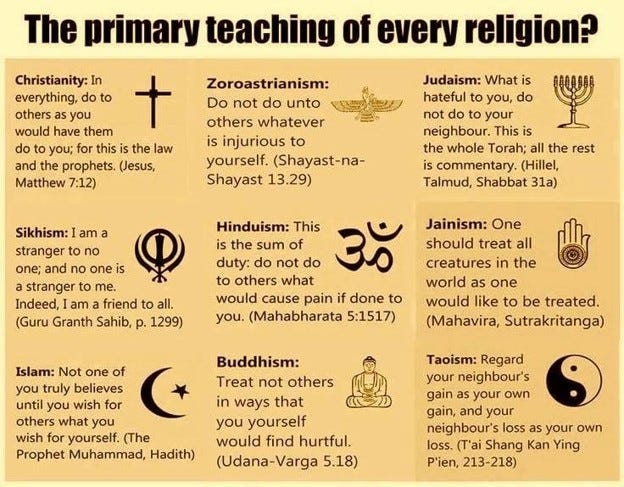
As Aldous Huxley pointed out through his concept of the Perennial Philosophy, world religions are often different expressions of the same ultimate reality or divine source. All major traditions share a Golden Rule equivalent, making it arguably the most consistent moral thread in human history:
The New Testament: “Do unto others as you would have them do unto you.”
Buddhism: “Hurt not others in ways that you yourself would find hurtful.”
Islam: “No one of you is a believer until he desires for his brother that which he desires for himself.”
The core frequency is identical. As Dr. Amy-Jill Levine suggests, it is like Jesus’s parables being played on different instruments in different keys. Even though they are presented differently, they ultimately harmonize to create a richer, fuller orchestra of divine truth. All the prophets were singing from the same songbook; they were just singing different parts.
Even our understanding of time shifts when we look closely. Fr. Richard Rohr notes that one mistake we often make is thinking of eternity as something that happens later, “out there” somewhere. But eternity, by definition, never starts or stops. We’re in eternity right now. The Kingdom of God is within our reach, in our midst, and within our hearts (Luke 17:21). Heaven and hell are here, every minute, depending on our choices. It has always been about heaven and earth becoming one.
Seeing Christ in the Suffering and the Small
This expansive view of Christ changes how we interact with the world—and how we endure its pain.
When Fr. Richard Rohr wrote his book The Universal Christ, he dedicated it to his fifteen-year-old Black Lab, Venus, whom he had to release to God. He wrote without apology or fear of heresy that Venus was also Christ for him, reminding us that the first incarnation of God is in Creation itself—that “God loves things by becoming them.”
Falling in love with a dog—or any part of this fragile creation—is a formula for heartbreak. But it is also a painful heart-opener.
It forces us to confront the heavy question: Why does God allow suffering? In his book Jesus Untangled, author Keith Giles tackles this “Big Enchilada” head-on. He notes that nothing forces a person to confront their true self like suffering; it turns our focus inward to face the parts of ourselves we would otherwise ignore.
While some theologians argue that perfect love is not coercive—meaning God doesn’t control or intervene directly but works behind the scenes to bring good out of tragedy—we have to be honest with ourselves. Keith Giles points out that most of the suffering in our world is entirely artificial. We have the resources right now to solve world hunger, war, famine, and systemic disease. We simply haven’t made them a priority.
Maybe instead of asking why God allows these things to happen, we should ask ourselves: Why do we allow this suffering to continue?
Jesus redefined righteousness not as external rule-following but as internal heart transformation, favoring the humble and merciful over the powerful. It is an upside-down Kingdom where the greatest among us are those who serve, and the first are last.
Humility Over Ego
Even with these convictions, the internal conflict remains real. I am often reminded of the Apostle Paul’s transparency in Romans 7:18: “For I have the desire to do what is right, but not the ability to carry it out.” It validates the permanent struggle between our highest ideals and our flawed human nature.
To navigate this, we need immense humility. Author and pastor Francis Chan noted that we have largely lost a true sense of the holiness of God, which has allowed pride to grow and fester among us:
“Everyone seems to start out with the assumption that their opinion of a situation or of God is right, rather than recognizing that all of us have an incomplete, flawed knowledge of God. Without humility, we will never have unity.”
When we lose that humility, our ego takes over. As the teachers at Free to Be remind us, the ego is always at war with the Spirit of God. It focuses only on what is good for “me” and forgets what is good for us.
I may very well be too liberal for the Christians and too Christian for the liberals. But I am content to stay on the margins, walking this pilgrimage. As Zig Ziglar once said, “Don’t judge me by my past. I don’t live there anymore.” I’m moving forward, listening for the harmony, and trusting that the mystery is big enough to hold all of us who are simply trying to find our way home.