

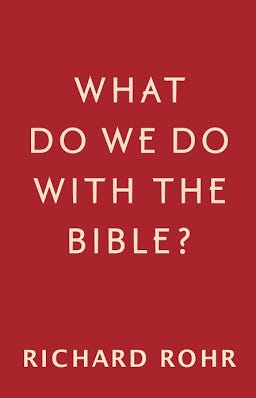
I found Richard Rohr’s book "What Do We Do with the Bible?" Awesome. That one comment: “God could have handed down a concise guide like ‘The 7 Habits of Highly Holy People. Made me think.
His point centers on three key insights:
1. The Desire for a "Rulebook" vs. the Reality
of Scripture
Most people approach religion wanting a straightforward,
black-and-white handbook: a neat checklist or a step-by-step formula for
holiness. Rohr points out that if God wanted to give us a simple manual, God
could have handed down a concise guide like "The 7 Habits of Highly Holy
People."
Instead, we were given the Bible: a vast, messy, multi-genre
library full of poetry, history, paradox, contradiction, and evolving human
consciousness.
2. Spiritual Transformation Over Moral Transaction
A "7 Habits" approach treats holiness as a
technique or a set of moral behaviors to manage from the ego (what Rohr often calls the "first half of life" or the "separate self").
Rohr argues that the Bible’s complex, often messy narrative
forces us out of simple behavioral management into contemplative wrestling,
discernment, and genuine transformation. We cannot simply look up an easy
answer; we have to develop the eyes and heart to see how God moves through
human messiness.
3. Reading the Bible Through the Lens of Jesus
Rohr emphasizes that the biblical text is not a flat set of
uniform rules, but a trajectory pointing toward divine mercy, inclusion, and
love. By recognizing that the Bible is not a simple 7-step guide, readers are
freed from literalism and fundamentalism, allowing them to engage Scripture
relationally and contemplatively—just as Jesus did.
Here are the additional points and themes from the book:
1. The "Jesus Hermeneutic"
Rohr argues that the best way to read the Bible is to read it exactly the way Jesus read his own Hebrew Scriptures. Jesus did not treat every passage with equal weight. Instead, he read "between the lines," consistently highlighting texts that promoted mercy, inclusion, and compassionate justice, while quietly ignoring or actively subverting passages that were punitive or exclusionary.
Book Hero
2. A Trajectory of Consciousness
Rather than viewing the Bible as a flat, flawless document that fell from heaven, Rohr describes it as a record of humanity's evolving experience of God. He calls the Bible a "text in travail" that mirrors the growth of human consciousness. He notes that the text often takes "three steps forward, two steps back". As you read through the Bible chronologically, you can trace a clear trajectory: humanity slowly moves away from viewing God as a tribal, violent, and punitive deity, culminating in the nonviolent, entirely gracious God revealed in the person of Jesus.
3. "Change the Seer, Not the Text"
A core thesis of the book is that the problem usually isn't the Bible itself; it's the spiritual maturity of the person reading it. Rohr insists that "only transformed people can be entrusted with inspired writings". If the Bible is read by someone operating out of ego, fear, or a desire for power, they will inevitably weaponize the text to justify their own prejudices. Rohr's goal is to transform the reader so they approach the text with the "mind of Christ" (focused on love and relationship) rather than dualistic or judgmental thinking.
4. Selective Reading is Inevitable
Rohr points out that everyone cherry-picks the Bible—preachers, politicians, and everyday readers alike. Historically, selective reading has been used to justify slavery, apartheid, misogyny, and homophobia. Since everyone is selective, Rohr suggests we be honest about it and ensure our "cherry-picking" aligns with Jesus's trajectory: prioritizing relationship, transformation, and universal love.
In short, Rohr teaches that the Bible is not meant to be a static rulebook, but a dynamic tool that invites the reader into a deeper, more loving relationship with God and the cosmos
Core takeaway: Rohr means that holiness cannot be
reduced to a tidy self-help formula. The Bible was deliberately given to us as
a complex, dynamic story so that we would have to rely on spiritual maturity,
the guidance of the Spirit, and genuine inner conversion rather than a simple
checklist.

I always appreciate Rohr. He's one of a few who metion everything you wrote. I would just add this. The Bible points to Jesus who embodies love, inclusion and peace. Jesus points us to the Father. I also think other sacred writings among the eastern religions point us towards the divine as well, whether we call that God, Brahman, Vishnu or the Ground of all Being. And the east like the west, has also made the same mistake of supposing these writings as rule, or doctrines. Both mistake the finger pointing to the moon as the moon. The problem isn't in the writings, it with the reader/interpreter.
Richard Rohr, what a great place/person to start! 😉🙏