

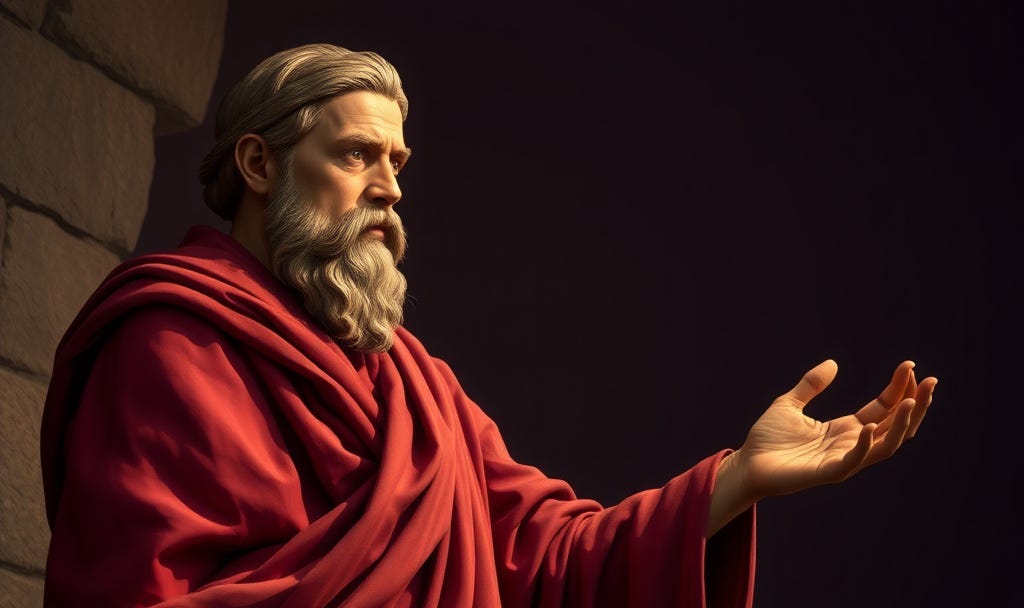
Paul of Tarsus: The Architect of Christianity
Core Thesis: While Paul the Apostle (originally Saul of Tarsus) and Jesus of Nazareth lived during the exact same period in the first century, they never actually met in person during Jesus’s earthly life and ministry. Pauline Christianity shaped the modern church far more than the historical Jesus did.
Yet Paul became the premier missionary to the Gentiles and the author of thirteen New Testament epistles. Ultimately, his entire theology and understanding of Christianity were built on post-crucifixion spiritual revelations, rather than direct, physical discipleship under the historical Jesus.
How did a man who never heard Jesus preach become the church's ultimate authority on what that preaching meant?
I. The Man and His Conversion
Paul began his life as Saul, a Pharisee, a zealous Jew, and a fierce persecutor of early Christians. His trajectory dramatically shifted on the road to Damascus (c. AD 37) when he claimed a direct encounter with Jesus Christ. Appearing in a blinding flash of light, Jesus commissioned him as an apostle. Paul later argued that his authority wasn't granted by any human institution or disciple, but through this visceral, divine revelation.
II. The Missionary Force
While Jerusalem was the birthplace of the Church, Antioch (in modern Antakya, Turkey) served as the launchpad for Christianity's expansion into the Gentile world.
From there, Paul became an unstoppable force. He covered an estimated 10,000 miles and established at least fourteen churches. During his first missionary journey (Acts 13–14), he founded the church in Philippi around AD 50–51, widely considered his first church plant and the very first Christian church established in Europe. Its earliest converts included the Philippian jailer and his household, as well as Lydia, a prominent dealer in purple cloth.
III. Visions of a "Third Heaven"
Paul's theology was deeply rooted in the mystical. In 2 Corinthians 12:2-4, he describes a profoundly personal spiritual experience, claiming he was caught up to "the third heaven" (which he also calls "paradise"). He emphasizes the event's incomprehensibility, noting he didn't know whether he was in his body or out of it. During this vision, he heard "things that cannot be told, which man may not utter."
IV. Navigating Culture: Women and Sexuality
As he built the early church, Paul had to navigate the complex social dynamics of the first-century world.
On Women: Paul taught the radical concept that men and women are spiritually equal—"one in Christ." However, he simultaneously insisted on a strict social hierarchy within the church assembly. Often reflecting the conservative cultural norms of his era, he advised that women should be silent, modest, and not hold authority over men.
On Sexuality: Believing that Christ's return was imminent, Paul held a personal bias favoring celibacy, seeing it as the ideal state for dedicated ministry. He firmly condemned all sexual activity outside the heterosexual marriage bond, viewing marriage as the sole legitimate context for sex.
V. The Core Disconnect: Jesus’s Spin Doctor?
To call Paul "Jesus’s spin doctor" suggests he significantly reshaped the core theological message of Christianity, pivoting away from the original teachings of the historical Jesus.
Biblical scholarship largely supports this view. Consider the timeline:
Paul wrote his letters roughly twenty years after the crucifixion.
Across thousands of verses, he quotes Jesus's earthly teachings only a handful of times.
In Galatians 1:11–12, he states plainly that he received his gospel by revelation, not from the men who had actually walked with Jesus. He even adds, seemingly as a point of pride, that he didn't bother consulting them (1:16–17).
Of the thirteen letters attributed to him (seven of which are undeniably his), none focus on Jesus the person. What modern believers are taught about Jesus is, in reality, Paul's interpretation of Jesus.
VI. The Enduring Legacy
Most scholars conclude that while Jesus remains the central figure of the faith, Paul's contributions catalyzed the transformation of a localized Jewish sect into a global religion.
The Theological Shift: What was ultimately lost in the centuries that followed was the radical, earthly prophet from Nazareth. He was largely replaced by the cosmic Christ—a theological figure whose primary purpose was to die for human sin, while his demanding, terrestrial teachings about peace, poverty, and systemic justice were quietly moved into the background.
Your deep knowledge of Christianity and its roots is amazing!