

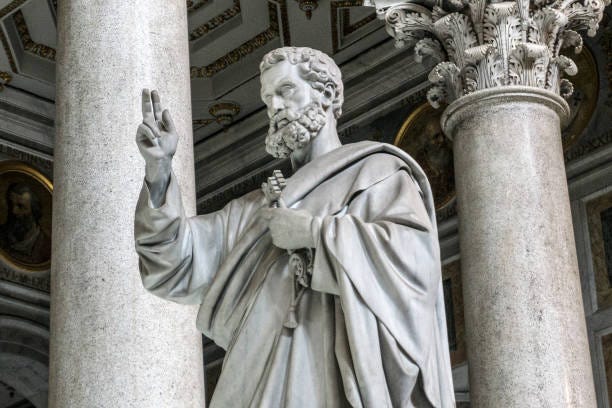
I have often wondered how this conversation would unfold. Many people hold strong opinions about the Apostle Paul, and when I wrote my article, Paul of Tarsus: The Architect of Christianity, “Jesus’s Spin Doctor,” I was not trying to be flippant.
Paul and Jesus were alive at the same time. Jesus was likely born around 6–4 BCE and died around 30–33 CE; Paul was likely born in the first decade CE, making him a younger contemporary of Jesus
Jesus provided the event: His earthly ministry, teachings, death, and resurrection were the central actions of salvation.
Paul provided the explanation: His role was to explain what the actions of Jesus actually meant for the rest of the world, answering the question of how the death of a Jewish rabbi affects a Gentile living in Rome or Greece.
FULL DISCLOSURE: AI WAS USED TO CREATE THE FICTITIOUS CONVERSATION
Here is the reimagined encounter, set years after the road to Damascus. The tension here is no longer between enemies, but between two different visions of the same movement: the earthly, ethical focus of the historical Jesus versus the cosmic, mystical theology of the Apostle Paul.
An Imagined Encounter: Jesus and the Apostle Paul
If Paul and Jesus had conversed in a mystical encounter late in Paul’s ministry, the fierce antagonism of his youth would be gone. In its place would be a profound, yet tense, dialogue between the itinerant rabbi who preached the Kingdom of God to the poor and the scarred apostle who transformed that message into a universal theology of grace.
Paul now bears the physical marks of his ministry. He is focused on the cosmic significance of the cross, the inclusion of the Gentiles, and the mystical union of the believer with Christ.
Here is what that post-Damascus encounter might have sounded like:
Paul: Lord, I have taken your name to the edges of the empire. The synagogues reject me, but the Gentiles are pouring in. I tell them they do not need the yoke of the Law—they are justified by faith in you alone. The old boundaries are gone.
Jesus: I see the churches you plant, Paul, and the suffering you endure for my sake. You have opened the gates wide. But tell me, in these churches of yours, are the hungry being fed? Are the wealthy forgiving debts? When I walked the hills of Galilee, I proclaimed a Kingdom that belonged to the poor and the meek.
Paul: They share the bread and the cup, Lord. But the true miracle is the mystery of the cross! Through your death and resurrection, the cosmic order has shifted. It is no longer I who live, but you who live in me. We are a new creation.
Jesus: It is a beautiful mystery, Paul. But beware that your followers do not turn my life into a mere transaction of the mind. You speak of cosmic salvation and heavenly courts, but my yoke was about how to treat the neighbor at your door. I taught them to love their enemies and turn the other cheek.
Paul: Without your resurrection, our faith is entirely in vain! If I only teach them ethics, they are still slaves to sin. The Law could never save us; it only pointed out our flaws. I must preach grace so radical that it unites Jew and Greek, slave and free, male and female into one body.
Jesus: You have grasped the unitive heart of the Father—that all are one. But as your letters circulate, men will twist your words. They will build new institutions, create new laws out of your theology, and put women and slaves back in their place. They will worship me as a heavenly king, but forget to follow me as a servant.
Paul: I write with tears, fighting to keep them rooted in the Spirit, not the flesh. I am trying to build a bridge wide enough for the whole world to cross into God's presence.
Jesus: And you have built a remarkable bridge, Paul. Just ensure that when they cross it, they find a Kingdom of justice and mercy, not just a new set of dogmas to argue over.
The Tension of the Two Voices
Placing the post-conversion Paul in conversation with the historical Jesus highlights the primary theological debates that still shape biblical scholarship today:
Ethics vs. Theology (The "Second Founder"): The dialogue highlights the shift from Jesus's Sermon on the Mount (action, justice, earthly ethics) to Paul's Epistles (justification, grace, cosmic salvation). Scholars continually debate whether Paul expanded Jesus's message to the world or fundamentally altered its original focus.
The Mystical Union: Paul's post-Damascus language shifts dramatically toward non-dualism. His focus moves from strict boundary maintenance to a unitive consciousness ("Christ lives in me," "one body"). Contemplative theologians view this not as an abandonment of Judaism, but as the ultimate realization of God's universal presence.
The Institutional Risk: Jesus's warning to Paul reflects the scholarly consensus regarding the "disputed" letters of Paul (like Timothy and Titus). While the authentic Paul preached radical egalitarianism ("no male and female"), later writers using his name reintroduced Roman household codes, turning a radical movement back into an institutional religion.
Nice twist posing the dialog.