

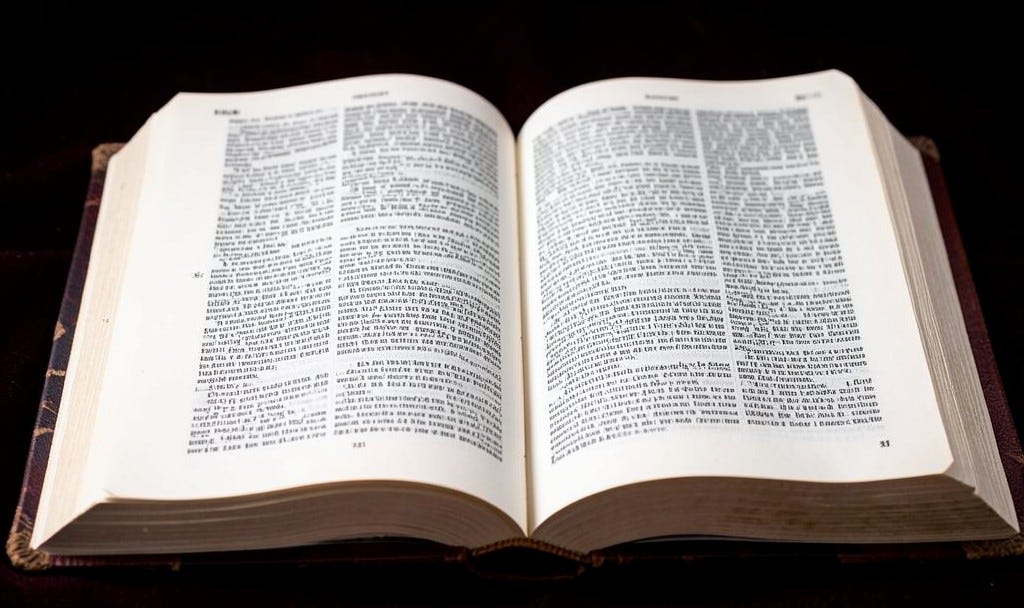
A Library, Not a Book: Rethinking How We Read the
Scriptures
We call it "The Good Book," as if it were a single volume with a singular voice,
neatly bound from cover to cover with a uniform theology and a single author.
But anyone who spends time studying it knows that calling the Bible a "book" is a category error.
The Bible is not a book. It is a library—an
expansive, centuries-spanning collection of anthologies, histories, legal
codes, lyric poetry, prophetic warnings, apocalyptic visions, proverbs, and
intimate correspondence.
Approaching the scriptures this way doesn't diminish them;
it unlocks them. When we let go of rigid, mechanical models of divine dictation
and embrace the messy, brilliant, deeply human reality of the biblical text, we
move from reading it literally to taking it seriously.
What the Bible Is Not
To truly understand what scripture is, we must first clear
away common misconceptions.
The Bible is not a flat, uniform theological textbook where
every text speaks with a single, unvarying voice. Nor is it a modern science
textbook, a synchronized historical archive, or an infallible rulebook that
provides direct answers to every contemporary ethical dilemma. It does not drop
down from heaven fully formed as a mechanical dictation, erasing the distinct
personalities, historical moments, and stylistic preferences of its many human
authors.
Recognizing what the Bible is not frees us from forcing
every verse into a rigid mold, allowing us to encounter the text in its
authentic, dynamic context.
1. From Monolith to Mosaic: The Library Metaphor
If you walked into a physical library and pulled every
volume off the shelves—from ancient Near Eastern creation myths to Hellenistic
love poetry, from political polemics written under Roman occupation to pastoral
letters written to fledgling house churches—you would not expect every book to agree
on every detail, nor would you expect them to share a single literary style.
That is precisely what we find between the covers of the Bible:
2. A Human Book: History, Culture, and Context
To say the Bible is a human book is simply to state what is
historically and textually evident. It was written in human languages (Hebrew,
Aramaic, and Koine Greek) by human hands, using the idioms, scientific
assumptions, cultural norms, and literary tropes of the ancient Mediterranean
world.
Recognizing the human fingerprints on the page frees us from
the impossible burden of defending historical inaccuracies, scientific
pre-modernity, or ethical contradictions as if they were timeless cosmic
mandates. Instead, we can see the Bible for what it is: the preserved artifact
of real human communities wrestling with the transcendent.
3. Taking It Seriously, Not Literally
A profound difference exists between reading a text literally and taking it seriously. When we read it this way, the Bible ceases to be a static
rulebook or an ancient instruction manual. It becomes a living conversation
partner.
4. A Daily Practice of Wisdom and Poetry
For those who study it daily, the library of Scripture offers something far more enduring than doctrinal certainty: a mirror for the human condition. It is filled with life lessons, soaring poetry, raw lament,
and profound beauty. It doesn't need to be infallible or uniform to be
invaluable. It simply needs to be read for what it truly is: a vast, honest,
human library that still teaches us how to be human.
Why This Matters
Shifting our view of scripture from a single, closed book to an honest, diverse library is not merely an academic exercise; it is essential for a resilient, living faith. When we treat the Bible as an infallible monolith or a flat
rulebook, we set it up for failure the moment we encounter a historical
discrepancy, a difficult text, or a shifting cultural question. We are
forced into intellectual gymnastics, often abandoning our faith or distorting
history just to defend an unsustainable model of perfection.
Conversely, when we embrace the library for what it truly is—a symphony record of real people wrestling with God across centuries—we are liberated. We no longer need to force every voice into uniform agreement. Instead, we can listen to the debate, feel the weight of the human struggle, and hear the divine whispering through the chorus. It transforms scripture from a fragile museum piece into a dynamic, trusted companion for life's journey.