

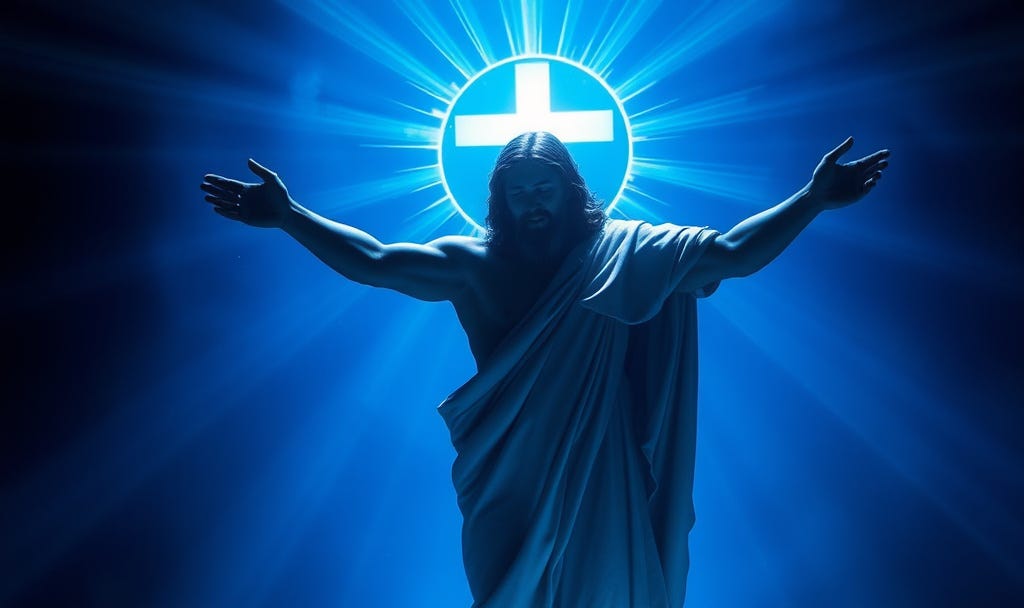
To understand the depth of Christian spirituality, we must first correct a common misunderstanding: “Christ” is not Jesus’s last name.
Author Richard Rohr points out that we have confused a title with a surname. I agree, and I see Christ in everything!
1. The Title, Not the Name The word “Christ” functions like the word “King” or “President.” It is a designation of role, not identity.
2. The Translation Chain
Greek: It comes from the word Christos, which means “The Anointed One.”
Hebrew: This is the direct translation of the Hebrew word Mashiach (Messiah).
3. The Meaning When we say “Jesus Christ,” we are not just identifying a person; we are making a claim. We are saying that Jesus is the long-awaited King and Deliverer promised in the ancient prophecies to restore humanity.
But it goes deeper than just a title. In the lens of the Universal Christ, “The Anointed One” refers to the presence of God infusing all of creation. It is the ‘Divine DNA’ that connects every living thing and the force of love that pulls the universe toward unity.
The Distinction: The Person vs. The Mystery
To grasp this, we must distinguish between the container and the content:
Jesus is the Person. He was the historical man who lived in Palestine 2,000 years ago, limited by time and space.
Christ is the Mystery. This is the universal “blueprint” or “template” for reality that has existed since the very beginning of time.
Jesus is the specific example; Christ is the eternal process of God manifesting in matter.
How This Changes Everything
When we view the world through this lens, our understanding of faith expands in four profound ways:
1. Christ as Cosmic Reality (The “Logos”) Progressives view Christ as the Logos (the Word/Pattern) mentioned in John 1. Christ is the “glue” that holds the universe together (Colossians 1:17).
The Implication: The physical world isn’t “fallen” or “evil”; it is the first body of God. Nature, science, and the cosmos are all filled with the Christ presence.
2. Jesus as the “Face” of the Christ If the Universal Christ is the invisible electricity, Jesus is the lamp that showed us exactly what that electricity looks like when it lights up a human life.
The Goal: We don’t worship Jesus because he is a “magical exception” to humanity. We follow him because he is the perfect example of what humanity looks like when it is fully aligned with God’s love. The goal is not just to worship him, but to imitate him—to let the Christ come alive in us.
3. Christ as Solidarity (The Justice Angle) This theology moves faith from the sanctuary to the streets. Christ is defined as the divine presence found specifically in the marginalized and the suffering.
The Action: In Matthew 25, Jesus says, “Whatever you did for the least of these, you did for me.” This means the Christ is the hungry person, the imprisoned person, and the outsider. You don’t find Christ just in a church service; you find Christ by standing with those who are excluded.
4. Christ as Your “True Self” Finally, drawing on mystics like Thomas Merton, we realize that “Christ” is the name for the deepest part of your own soul.
The Transformation: Salvation isn’t about getting “saved” from hell; it is about waking up to your True Self—the part of you that is already one with God, loved, and whole—and letting go of the False Self (the ego, status, and division).
In Short
To “believe in Christ” doesn’t mean agreeing to a list of dogmas about a virgin birth or blood atonement. It means trusting that the universe is benevolent and participating in the flow of love and justice that Jesus modeled.